


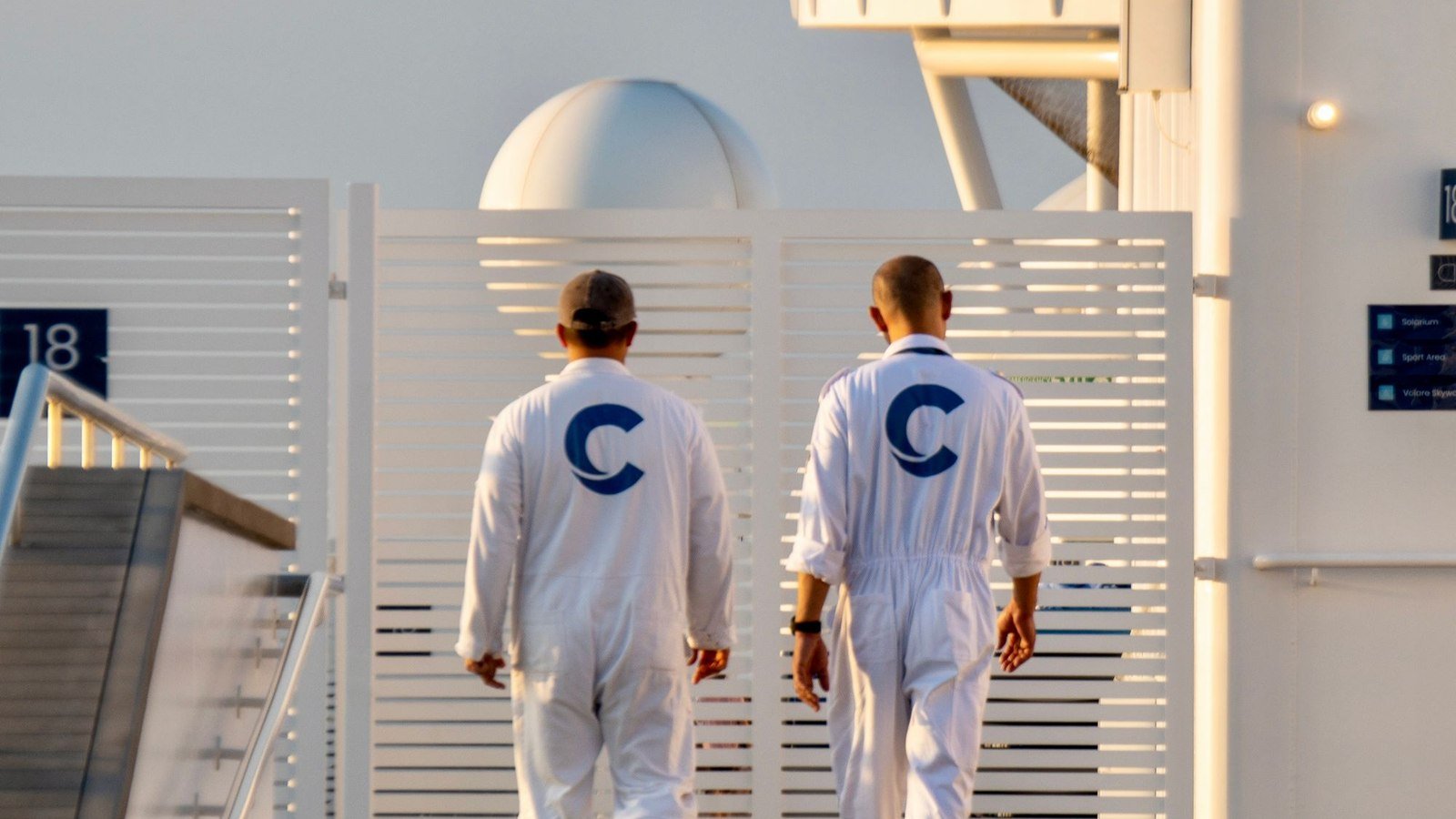
Most people looking for work in Dubai think of hotels, malls, construction and the airport. They miss an entire industry moored a few kilometres from the city centre: from roughly October to April, cruise ships base themselves at Mina Rashid and Dubai Harbour, and each one carries between 700 and 1,600 crew who are recruited, replaced and rotated throughout the season.
This guide is a complete introduction to cruise ship jobs in Dubai for 2026 — how the industry hires, which departments take first-time crew, what you genuinely earn once free cabin and meals are counted, what paperwork you need before anyone will look at you, and how to apply without paying a single dirham to anybody. Every figure below is an indicative range that varies by cruise line, ship and department; the number that counts is the one written into your own contract.
Dubai Cruise Jobs Overview
| Details | Information |
|---|---|
| Topic | Cruise ship crew jobs on vessels operating from Dubai during the Gulf season |
| Where the ships are | Mina Rashid and Dubai Harbour cruise terminals, roughly October to April |
| Cruise lines in the region | MSC Cruises, Costa Cruises, AIDA, TUI Cruises, plus premium and luxury brands on Gulf itineraries |
| Departments hiring | Housekeeping, Food & Beverage, Galley, Deck, Guest Services, Entertainment, Retail & Spa |
| Typical gross pay | USD 600 – USD 3,000 per month (roughly AED 2,200 – AED 11,000), plus the service-charge pool in service roles |
| Employment law | The ship’s flag state plus the Maritime Labour Convention 2006 — not UAE labour law |
| Contract length | Typically 6 to 9 months on board, followed by 6 to 10 weeks of unpaid leave |
| Provided free | Shared cabin, all meals, uniform laundry, onboard medical care, joining flight and repatriation |
| How to apply | Directly on the cruise line’s careers portal, or through a licensed manning agency and LinkedIn UAE Jobs |
| Application fee | None — charging a seafarer for a job is prohibited under MLC 2006 |
What Cruise Ship Jobs in Dubai Actually Are
A cruise ship is a floating hotel, restaurant group, theatre, shop and utility plant that also has to be navigated. That is why the crew list reads like a small town’s employment register: housekeepers, waiters, cooks, dishwashers, bartenders, receptionists, technicians, security officers, entertainers, retail assistants and deck crew, all living and working in the same hull.
The important thing to understand before you apply is who your employer is. You are not hired by a Dubai company. You are hired by the cruise line, and your contract sits under the law of the country the ship is registered in, together with the Maritime Labour Convention 2006. Dubai is simply where the ship is based for the season and where you join and leave it.
Why the Dubai Season Matters for Jobseekers
Because Dubai is a homeport rather than a passing stop, full crew changes happen here. Ships turn around in the city every week of the season, joining crew fly into Dubai International, and manning agencies plan their intakes around those dates. That makes the Gulf season a genuine, predictable hiring window rather than a rumour.
It also sets your application calendar. Recruitment for a winter Gulf deployment mostly runs from June to September, with joining dates from October. Apply inside that window and you are applying into a live intake; apply in January and you are joining a waiting list for next season or hoping for a mid-season replacement.
If you are weighing cruise work against shore-based options, it is worth reading alongside our guide to top job opportunities and career growth before you commit to a six-to-nine-month contract at sea.
Main Job Categories
Housekeeping & Cabin Crew
Cabin stewards service a fixed section of guest cabins twice a day to a strict time standard, and housekeeping attendants cover public areas, corridors and crew quarters. This is the largest single department on most ships and the widest open door for first-time crew, with training given on board.
Food & Beverage Service
Waiters, assistant waiters, buffet attendants and bar staff serve in the main dining rooms, buffet and bars. These roles have a modest base wage and the largest share of the pooled service charge, so they are usually the best-earning entry grades on the ship.
Galley & Kitchen
Kitchen helpers, dishwashers, commis chefs and chefs de partie feed several thousand people a day under HACCP food-safety rules. Utility and helper grades take freshers; commis level upwards expects culinary training or documented kitchen experience.
Deck & Technical
Deck hands, able seafarers and technical ratings handle mooring, tender operations, maintenance and the ship’s systems. These roles need STCW certification and, at the higher grades, documented sea time. Higher base wages, but no share of the service-charge pool.
Guest Services & Entertainment
Receptionists, guest relations officers, cruise staff and photographers deal with guests directly all day. Strong English is essential, a second language is a real advantage, and confidence in front of people matters more than formal qualifications.
Retail, Spa & Onboard Revenue
Shop assistants, spa therapists and fitness staff work to sales or treatment targets with commission on top of base pay. Spa roles require a recognised therapy qualification; retail roles usually accept shop experience from ashore.
Who Can Apply — Eligibility
- Age: 18 or above for almost all shipboard roles; some brands set 21 for bar service depending on the itinerary.
- STCW Basic Safety Training: the five mandatory modules from an approved centre. You cannot legally sign on to a ship without it, and certificates last five years.
- Seafarer medical: an ENG-1 or MLC-recognised equivalent from an approved examiner, including a dental check.
- English: CEFR B1 or above, usually evidenced by the Marlins test. English is the working language on board, whatever the ship’s flag.
- Passport: valid for at least 18 months with blank visa pages, plus a police clearance certificate.
- Physical fitness: long shifts, seven days a week, in a confined environment for the whole contract.
- Nationality: open worldwide — crew are employed under the ship’s flag state, so there is no UAE nationality or residence requirement.
Information & Documents Commonly Required
- Passport with at least 18 months validity and blank visa pages.
- Seafarer’s book or Continuous Discharge Certificate, where your country issues one.
- STCW Basic Safety Training certificates covering all five modules.
- Seafarer medical fitness certificate from an approved examiner.
- Police clearance certificate, plus any transit or crew visas for the ship’s ports of call.
- Marlins English test result or equivalent evidence of your English level.
- A one-page seafarer CV with a photo, height and weight for uniform sizing, and exact employment dates.
Salary & Benefits Overview
| Position | Typical Monthly Base (USD) | Experience | Usual Extras |
|---|---|---|---|
| Dishwasher / Utility | 600 – 900 | Freshers OK | Cabin + meals free |
| Kitchen Helper | 700 – 1,100 | Freshers OK | Overtime paid |
| Cabin Steward | 700 – 1,300 | Freshers OK | + service-charge pool |
| Assistant Waiter | 700 – 1,200 | 0 – 1 yr | + large service pool |
| Bartender / Waiter | 1,200 – 2,000 | 2 yrs+ | + service-charge pool |
| Deck Hand / Able Seafarer | 1,200 – 2,000 | STCW + sea time | Overtime, no pool |
| Guest Relations / Supervisor | 1,600 – 3,000 | 2 – 4 yrs | Full package |
The base wage is only half the picture. Your shared cabin, all meals in the crew mess, uniform laundry and medical care on board are free for the entire contract, and the employer books and pays your joining flight and your repatriation at the end. With no rent, no commute and no grocery bill, junior crew commonly send home the large majority of what they earn. What still costs money is your internet package — the biggest crew expense by far — crew-bar purchases and anything you spend ashore on port days. Leave between contracts is normally unpaid, so budget for it.
★ The single most important rule: never pay for a job. Under the Maritime Labour Convention 2006, the cost of recruitment and placement is paid by the shipowner, not by the seafarer. A licensed manning agency cannot legally charge you a placement fee, a “contract guarantee” or a “visa deposit”. If anyone asks, walk away and report them.
Step-by-Step: How to Apply Online
Where to Find Official Openings
- Costa Cruises — cruise line with a long-running Gulf winter programme.
- Carnival Corporation — parent group of Costa, AIDA, P&O and other brands sailing the region.
- Silversea — luxury brand recruiting hotel and guest-service crew.
- CruiseJobs vacancy board — openings across multiple cruise lines.
- Dubai Harbour Cruise Terminal — one of the city’s two homeport terminals.
- DP World UAE (Mina Rashid) — operator of the Mina Rashid cruise terminal.
- ITF Seafarers — check a ship’s agreement and get help with unpaid wages.
- Marlins English Language Test — the standard English assessment used by cruise recruiters.
- IMO — STCW & the Human Element — the international seafarer training framework.
- LinkedIn UAE Jobs — reach cruise-line and manning-agency recruiters directly.
Cross-check every vacancy against the cruise line’s own careers page. If a job exists only in an agent’s message and nowhere on the brand’s own site, treat it as unverified until proven otherwise.
Training & Career Growth Programs
- Paid onboard induction: safety drills, muster duties, brand service standards and department training before your first solo shift.
- Food-safety certification: HACCP and allergen training is employer-funded for galley, buffet and bar crew.
- Internal promotion: a clear ladder from utility to attendant to supervisor to assistant head of department, filled almost entirely from within.
- Cross-department moves: crew who transfer between departments between contracts progress faster and become far harder to replace.
- Certification support: many lines fund advanced STCW modules and supervisory qualifications for returning crew.
Interviews at this level are practical rather than technical, so it is worth rehearsing the basics — our top job tips guide covers the fundamentals that apply just as well to a cruise video interview.
Worked Example
Vikram has hotel housekeeping experience but has never worked at sea. In June he books STCW Basic Safety Training and a seafarer medical at his own initiative, then creates profiles on two cruise lines’ careers portals and applies for cabin-steward positions on ships deploying to the Gulf.
In July a licensed manning agency contacts him naming one of those lines as its principal — a partnership he confirms on the line’s own website before sending any documents. He passes a video interview and a Marlins English test in August, and receives a seven-month Seafarer’s Employment Agreement with a base wage plus a share of the service-charge pool.
He pays nothing at any point. The line books his flight, its Dubai agent arranges his crew visa for joining at Mina Rashid, and he signs on in October. With cabin, meals and medical care free, he remits most of his earnings home and finishes the contract with a re-hire recommendation for the next season.
Common Mistakes to Avoid
- Paying any placement, “training-guarantee” or visa fee to an agent — MLC 2006 puts that cost on the shipowner, always.
- Assuming a cruise contract lets you live or work ashore in the UAE. It does not: you join on a seafarer’s crew visa or shore pass, not a residence visa.
- Accepting an offer that arrives only on WhatsApp, with no company email domain and no Seafarer’s Employment Agreement attached.
- Sending original documents — passport, seafarer’s book or certificates — before a verified contract exists.
- Applying for skilled grades such as commis chef or able seafarer without the training those roles screen for.
- Ignoring the rest-hours clause: a contract that does not respect MLC minimum rest will not respect anything else either.
- Forgetting that leave between contracts is unpaid, and failing to budget for it.
Your Rights & Staying Safe from Job Scams
Every legitimate cruise application is free, and that single fact is your best defence. Under MLC 2006 the shipowner pays for recruitment, placement and your joining travel, so no genuine recruiter will ask you to pay for training, a uniform, a background check or a “guaranteed” placement. If a message pressures you to act immediately, asks for bank or card details upfront, or refuses to name its principal cruise line, step away and report it.
Once employed you are entitled to a written Seafarer’s Employment Agreement, timely payment of wages, minimum rest of 10 hours in any 24 and 77 hours in any 7 days, free medical care on board, an onboard complaints procedure that cannot be used against you, and repatriation at the employer’s expense at the end of your contract. Keep copies of your contract and certificates off the ship as well as on it, and never hand your passport or seafarer’s book to anyone with no legal right to hold it.
Frequently Asked Questions
Does it cost anything to apply for cruise ship jobs in Dubai?
Do I get a UAE visa with a cruise ship job?
Can freshers with no experience get hired?
What do I need before applying?
How much can I actually save?
When should I apply for the Dubai season?
How long is a contract and are the hours long?
Is the pay tax free?
Conclusion
Cruise ship jobs in Dubai are a real and largely overlooked route into paid international work. The entry grades take first-time crew, the package removes almost every living cost, and the industry promotes from within — but it runs on paperwork and on a fixed seasonal calendar, not on luck.
Get STCW and your seafarer medical done before anyone asks for them, apply between June and September on the cruise lines’ own portals, verify any agency against the line it claims to represent, read the contract line by line, and never pay a single dirham for the job itself.
👉 Next step: Book STCW Basic Safety Training and a seafarer medical this month, then apply through Costa Cruises and the CruiseJobs vacancy board — online, and completely free.
